
1984 to 2010-ish (?)
The label “digital” is an attempt to label the graphic style which emerged in the 1990s as a result of the revolutionary changes in computer technology. Digital style is not a historical movement since it’s still happening. The term “digital” will be replaced once this trend has ended and historians can view it in perspective.
The loosening of the rules of the Swiss typographic movement and a renewed interest in experimental typography lead to an abandonment of convention when designers embraced the computer as a design tool. Like the psychedelic artists of the 60s, early digital artists tested the waters to see how far they could go. From April Greiman’s “hybrid imagery” to David Carson’s deconstructive page layouts, anarchy reigned supreme in the nineties.
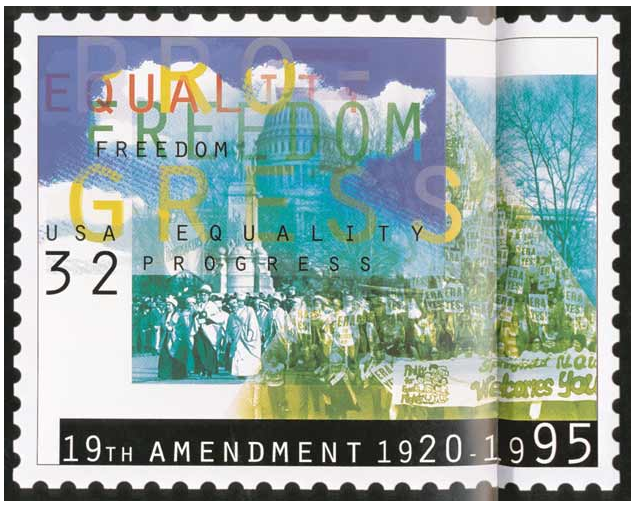
April Greiman
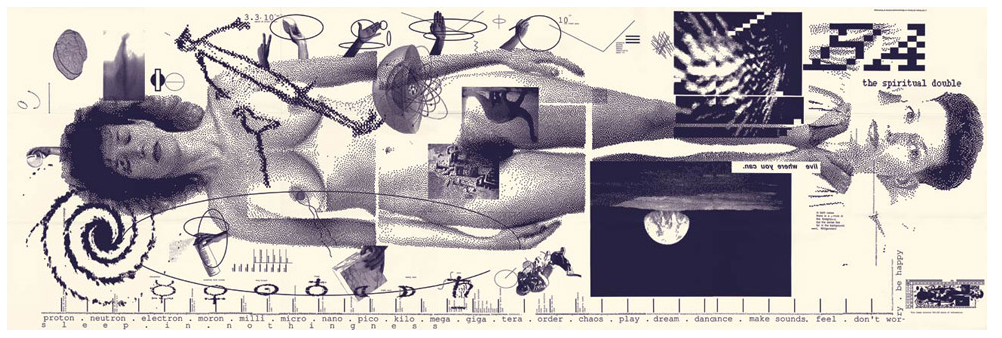
April Greiman
Grieman’s 1987 life-sized centerfold for Minneapolis Walker Art Center’s Design Quarterly has become an icon of the digital era. Above, her US Postage Stamp, 1995
David Carson did not go to art school but he did earn a degree in Sociology and he was a pretty decent surfer. With a very limited exposure to formal graphic design education, he nevertheless learned enough to pursue experiments with typography. Carson created some unorthodox, interesting and highly controversial work

Ray Gun magazine cover. David Carson
The Impact of the Computer and Digital Type on Graphic Designers
Untrained designers with Photoshop deteriorated the traditional standards of visual communication. Even many trained graphic artists have no understanding of our long history. Combine ignorance with the ability for anyone to publish anything with inkjet printers or as webpages, and you literally have design anarchy.
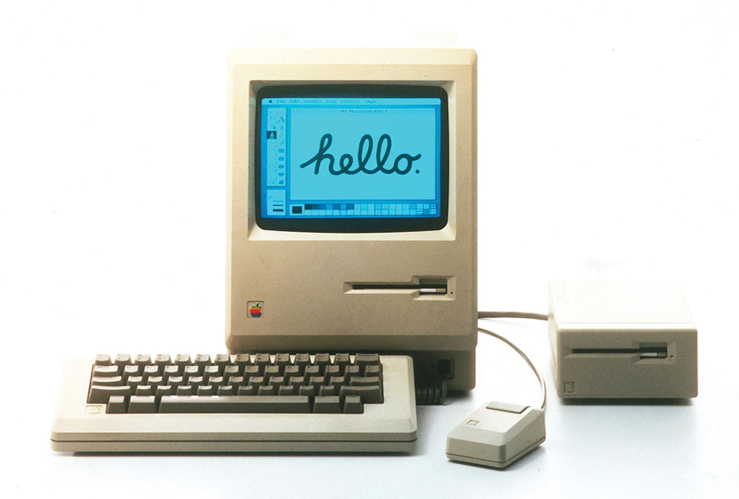 Once “desktop publishing” was mainstreamed there was complete shift in the role of the graphic designer. Many design support services closed or converted to the digital technology. Graphic designers were forced to take on the roles of typesetting and pre-press production, formerly not their responsibility. The graphic designer’s thinking skills were surpassed by the need for digital expertise. As Johanna Drucker has pointed out “The tools of the designer are confused with the skills of the designer … The accessibility of production tools has undercut the design profession since anyone could make a flier or a brochure.” Designers are now required to spend thousands of dollars on constantly updating hardware and software. They must continually upgrade their skills — Designers are now at the mercy of the industries they helped develop.
Where Does That Leave Us?
So does the computer mean the end of fine design? or is the computer forcing designers to reflect on what is good, useful, and beautiful?
Designer Steven Sagmeister has this to say about the issue:
Question: Do you think designers today need more technical ability as far as using the mac and/or design applications? If not, elaborate, and if so, what areas seem weak to you?
SS: Sadly, I think that is necessary. But only because we designers, as a profession, decided to take over other people’s jobs (color seps, type setters, retouchers) instead of concentrating on ours. In general, I think we should think more. Thinking, however, is difficult. Typesetting is easy.
Thinking is difficult. Typesetting is easy. The best digital work doesn’t look digital. Computers are logical machines, yet artists who use the computer as a creative tool are creating work that looks chaotic, anarchic, expressive, illegible. Not logical. This irony is what makes digital so interesting.


Designer as Artist
The line between art and design is, once again, blurring. Just as the early Modernists explored expression through art, design, and photography, a new generation of graphic designers are merging disciplines, resulting in exciting new visual forms. April Grieman, David Carson, and Steven Sagmeister were at the forefront of designers who produced digital work with such skill and imagination that it transcended the definition of design and is appreciated for it’s beauty and emotional power.
In June 2010, John Maeda wrote an article, published in Forbes magazine, entitled “Your Life in 2020.” In it, he offers a summary of what he stands for, as a designer, an educator and a leader. Maeda believes that art and design will be the foundation of culture in the near future, as technology fades from its prominent position. “So, what will take technology’s place?” he asks, and answers: “It begins with art, design and you.”
For interviews and portfolios of influential contemporary designers, visit the AIGA page.
I’d like to further this discussion with a link to Sagmeister’s “Answers” to design questions. Pretty relevant stuff:
For on the post-modern, digital revolution more please visit:
http://www.designhistory.org/Digital_Revolution.html
http://www.designhistory.org/Post_mod.html
 Graphic Design History
Really helpful article. Thanks for sharing!
Hi Ritvars, each page has a bibliography at the bottom.
I’m happy that you find this site useful. I taught graphic design and design history for decades and wanted my students to be aware of the evolution of design as well as understand what is meant by “Victorian” or “Art Deco” etc. I didn’t know when I created this website that so many students from all over would find it. Its wonderful.
This is fabulous! I am teaching a college-level course on Design Theory and Criticism and want to cover the evolution of graphic design. This takes me through each period beautifully! My students will read these works and respond. Perhaps, that can begin a blog of sorts/discussion board.
Hi! Even as this may count as an old blog from this point in time it’s still really great! Thank you for it. I’m doing a study and trying to dive deeper into all the in and outs of this subject. If I may ask, maybe you still have them or remember… Can you share some resources about what you’re writing about here? 🙂
thank you so much, for the great useful content
Digital has certainly made it a lot easier for graphic designers! Especially for those who don’t have great drawing skills.
I believe that the technological advancements actually help the most gifted graphic designers to stand out. With or with out the tech, a great designer can present their vision.
With thanks! Valuable information!
Shawnna, I do not know of any online discussions on the history of graphic design. I wish I did. I created this blog for my graphic design students – but the idea of a discussion board is great. Perhaps it can just develop here through comments?
Great blog you have here but I was wanting to know if you knew of any discussion boards that cover the same topics discussed here? I’d really like to be a part of community where I can get responses from other experienced people that share the same interest. If you have any recommendations, please let me know. Thanks a lot!